Wednesday, January 4, 2017

Tim Price Bloggin' For D'Addario Woodwinds- aspects about improvising & thoughts within.


Some of the most important aspects about improvising and playing jazz and also just plain improvise, playing in a jazz quartet, free playing, or behind a female vocalist or playing eight measure solo are rock 'n' roll gig. 

Each of your solos in the matter what the idiom… Should have a beginning… A middle and an end.


That's one of the age-old aspects of why something sounds good and has a focus personally. How somebody constructs that is as important as what notes they play and any other aspect that they apply.


Very simply-if your solo does not have a shape that includes a beginning middle and end-you're missing a very important part of your message.


If you take yourself and record 12 bars or eight bars and listen to it and listen to that shape you'll hear it right away. You can also use a solo transcription and graph it, if you do a solo by somebody like Cannonball Adderley or Louis Armstrong you'll see what I'm getting at immediately just take your pencil and graph out to solo.

You can hear this type of sound in anything from Louis Armstrong solos, Steve Douglas solos on early rock records, Steve Lacy solos and of course Monk solos. Of course Lester Young and Bird!


The ability to create space with others in this way has deepened as I’ve learned to be more present and aware within my own body and self. As I take time to connect with the whole of who I am on a daily basis, my mind has becomes quieter and I feel more in tune with my authentic self. From this space, I’m naturally able to be more present with others without loosing that inner connection to myself. Being present to someone in this way may not always seem ‘easy’. If you let yourself, you can easily become distracted by your thinking: including devising what you’ll say next; mulling over your judgements about the other person (or worrying about what they think of you); feeling a need to interrupt their speaking with your own opinion; or thinking about something else entirely. I’ve fallen into this trap too, many times.


Have you ever considered at what time are you the most creative or when is your mind highly productive? For some people it is when they just wake up in the morning or when they are about to go to sleep. Others find that they are most creative in the shower or when relaxing in the bath. I have also found that people are creative when they are driving along the highway or going for a relaxing walk. Interestingly, not many people actually state that they are most creative when at work, which could be the reason why our abilities to solve problems. The key to achieving a highly creative and productive mind is to move into a relaxed state of being, that is, when your mind enters the alpha state. Relaxation, music and mind set all equal a high creative state of mind.
I'm about not just playing jazz, or rock, blues,funk but making the music something lager than any word could describe. After all-the music is bigger than all of us! To get to a good train of thought requires practice and being aware of the world. You already have the answers...keep on your dreams and work hard. There's no quick fix or gear that will replace books, CDs and shed time. One bedroom video is only that, go out and play for REAL people.


I practice everyday, and I practice for at least 2 hours before I do anything. I don't do it because I think that Warren Haynes or Mike Stern or Bjork is going to call. < I wish they would > I do it because it's the one thing in life that has been a constant for me. So few things in life ever remain the same, if any. But the saxophone < and my woodwinds > is the same every day.To me, it's the best ever deal you can make in life. If you work hard and practice at your saxophone , you get better. It's that simple! Think about it. Still grateful to be playing and learning. Looking forward to each gig and rehearsal and student, trying to stay in that vibe. And learn what I can from it. All human beings are linked together through the timeless, universal chain of history and events.The musician links to the practice room and the bandstand. Various life developments have been born in both environs. ~ The first stage of the artistic process involves absorption of principles and techniques that have already been accepted as standard in the field , the artist personalizes past and contemporary styles, meaning active participation in real world. This is why, I've always felt the need to play with all kinds of musicians, any age and of course working heavily with students to develop their "real world" skills. So- till next week - practice hard and eat more vegetables and fruit. Don't forget to do something nice for somebody too, remember compassion is essential with each other......Tim Price Bloggin' For D'Addario Woowinds.


PS- Some stuff to shed below if your interested ;

..


Wednesday, December 28, 2016

Tim Price Bloggin' for D'Addario Woodwinds- Being flexible on dominant 7th chords.


I thought I'd take some time this week and define some 7th chords and their functions. It is something every improvisor needs more clarity on due to the amount of things to hear and play. Let's get started.

Seventh chords are the most common extension of the basic 3-note triad you come across.
A seventh chord is built by adding an extra note to a triad which is an interval of a 7th above the root note.
e.g. If you build a triad on C you will use the notes (C-E-G). If you add a another note a 7th above C then you will have C-E-G-B. You have just created a basic seventh chord.

The 5 Types of Seventh Chords

There are 5 types of 7th chord you will come across and want to use in your music. Each one gives a characteristic sound which will help you when composing music.

Major seventh chord

The major seventh chord has a much softer sound than the dominant seventh. Again, it is created by taking a major triad, but this time adding a note a major seventh (11 semitones) above the root.
e.g. a major seventh chord on C contains the notes C-E-G-B (B is a major seventh/11 semitones above C).
You will often see it written as CM7.


Keep in mind, these below are very easy to learn. But make sure you can hear and apply them.

Half-diminished seventh chord

The half diminished seventh chord is the first of the two 7th chords which give a feeling of tension.
It is created by taking a diminished triad and adding a note a minor seventh (10 semitones) above the root.
e.g. a half diminished seventh chord on C contains the notes C-Eb-Gb-Bb.
You will often see it written as a slashed circle followed by a 7 (see the table below)
Can you hear the feeling of tension you get with the half-diminished seventh chord?


Diminished seventh chord

The final seventh chord is the diminished seventh chord. This gives a very distinctive tense and scary feel.
It is created by taking a diminished triad and adding a note a diminished seventh (9 semitones) above the root.
e.g. a diminished seventh chord on C contains the notes C-Eb-Gb-Bbb). (Bbb is “B double flat”).
You will often see it written as a small circle followed by a 7 (see the table below)
As you can tell from the audio example below it is a brilliant chord to use if you want to create tension in your music.Hope this lesson has helped you understand seventh chords and given you some inspiration for your composing.
I have put together a summary below of  seventh chords to make things easy, and some


Secondary dominants- if you take a few minutes to try these, study them you'll be solid on these forever.

In connection with the dominant and predominant chords we discussed the meaning of the tritone as a tension-building ("dominant") interval. To recognize a key by ear, it is enough to hear the tritone resolve into either a major or a minor chord.
A major or minor triad can build on a variety of degrees of a key and sound "like the tonic" if preceded by its dominant chord. An example of this is the second degree chord (Dm) in C major preceded by A7 (V7 in D minor): the relationship between these chords is stronger than in the ordinary progression VI-II (Am-Dm). This is due to the tritone resolution: the third and seventh of A7 resolve into the root and third of Dm.
The dom7 always includes a tritone; since a major key only includes one tritone, secondary dominants always include altered notes.
The symbol for a secondary dominant is the dominant chord sign (V, Vs, or VII) followed by a slash (/). The slash is followed by the scale degree (secondary tonic) into which the secondary dominant resolves.
In the example below, we see the secondary dominant chords in C major with their secondary tonics (root + third) with scale degree symbols and absolute chord signs. A diminished triad, the VII degree does not have a secondary dominant (or the II degree of a minor scale).
The tritone resolutions of the same chords with consequent chromatic alterations are seen below:
If a minor third is added in the tritone, the result is a secondary dominant of the VII type. If another third is added on top of the tritone, the result is a secondary dominant of the VII7 type, which is a diminished four-note chord. A diminished chord includes two tritones; their proper resolution is shown in the example. While the diminished chord includes two tritones demanding resolution, the dominant type (V7/) secondary dominant is the most common because it builds a fourth relation to the secondary tonic.


 ALSO STUDY WITH TIM PRICE ON SKYPE....Contact Tim at timpricejazz@aol.com for more details on enrollment.

Thursday, December 15, 2016

Tim Price Bloggin' For D'Addario Woodwinds- TP's holiday blog chock full of stuff to shed, things to think about and TP's kitchen sink Xmas cookie recipe.

Tim Price Bloggin' For D'Addario Woodwinds- TP's holiday blog chock full of stuff to shed, things to think about and TP's kitchen sink Xmas cookie recipe.


Merry Christmas blog- stuff to shed. Change you life, change your sound and add some slide in your stride this holiday season. Also my " kitchen sink" cookie recipe, don't worry the lobster comes on NYE. HA!! And some long tone study's at the end- so you don't sound whacked out. There is a LOT here and stuff you do not find in books. EG- The Billy James lesson. Get started and keep your reed wet and practice your long tones and listen to Lester Young. Merry Christmas, Warmest Wishes for Happy Holidays and a Happy New Year. Cheers! 


This lesson with Billy James was a joy.It was published in JAZZ PLAYER in 1996. Billy was the drummer with the famous Sonny Stitt bands that featured Billy and Don Patterson. I was blessed to know & work with Billy and Don through various parts of my life. This lesson is something special- as Billy was one of the greatest organ group drummers in the world. BUT...one day I also found out he was deeper than that, of course. I gig in Philly was fouled up somehow- at the last minute we had no organ player. A Philly bassist Dylan Taylor was there to hang- and say hi to when we realized this. SO- WE WENT TRIO!! Billy- bass and me!! I couldn't stop playing...Billy inspired me so hard with this open sound within HIS THING and just going for it. To me- there was only one Billy James....guys like Sonny Stitt knew it- so did Lockjaw Davis and Eddie Harris. Read this and see why. God bless Billy- he was one of the real ones. ANY SAXOPHONIST...Worth their salt should know this man's playing. Get into the players like  this- find their groove and style. Your sax playing will get better quick- watch what happens. Jazz is a street music- everything that you learn in a classroom is one thing. KNOWING....your history and the players within the music is vital. No excuses!  Enjoy.


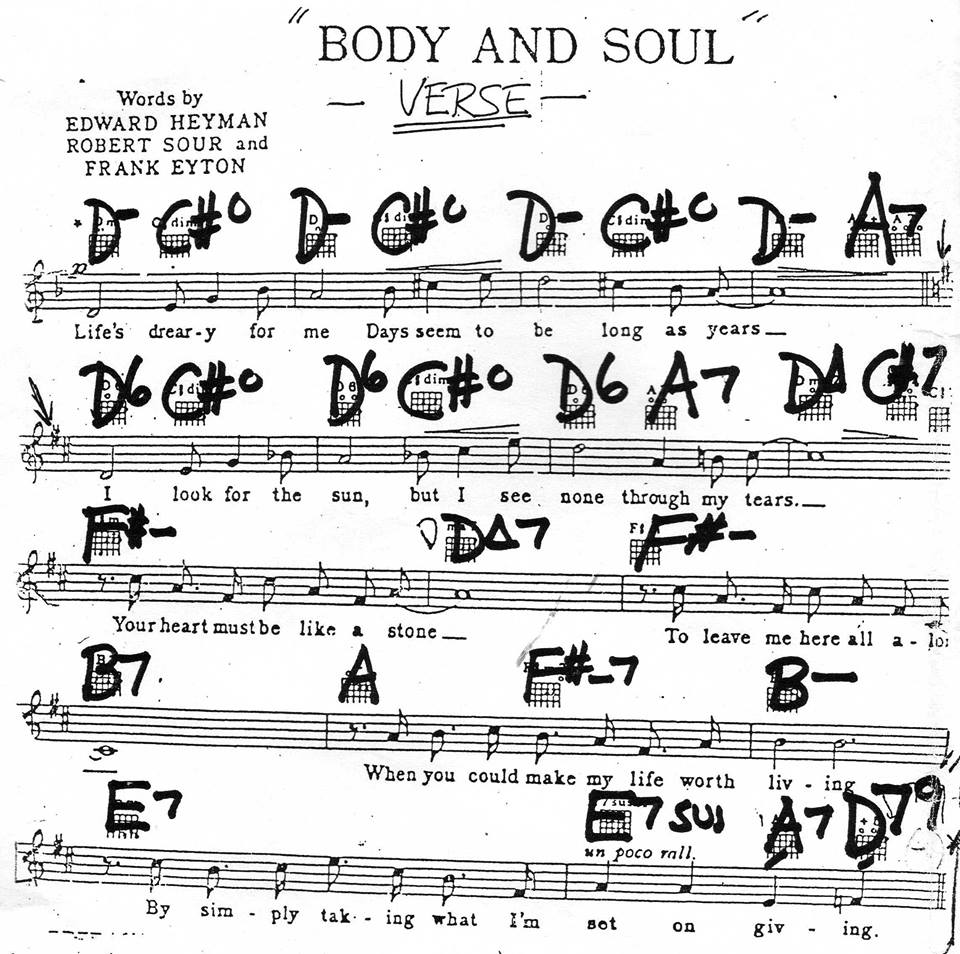
This is the _VERSE_To " Body & Soul" given to me by jazz legend Big Nick Nicholas. If your familiar with the Coltrane tune " Big Nick"....Well that's who this is.
I usually play this verse rubato then segue into the tune. I'm posting this as a respect to my friend BIG NICK..because he's not known as well as he should be, and by getting this out into everyone's hands...we all can keep the VERSE to this tune alive...and also one of the real tenor players in jazz BIG NICK.
Big Nick was also the man Bird went to, to get songs and ideas for them for his " Bird With Strings" recording.
I consider myself very lucky to have known Nick in this life...and this is a great way to keep his name alive...and legacy. If you play this...and pass it on...remember where it came from please.


SO THERE YOU GOT IT.....Practice and study this stuff.

Happy holidays from me to you and your playing. The best in the new year and remember to practice long tones everyday or you'll sound whacked out. You don't wanna sound whacked out do you?

SO...Dig and study the long tones page below. AND...don't think that your getting thru the holiday without a TP Xmas cookie recipe?
Nooooooo....It's right below the long tones.

Enjoy these blog as much as I enjoy doing it- Happy holidays.

~  TIM PRICE...D'Addario Woodwinds blogger- artist.


Ingredients

1
(17.5 ounce) package Betty Crocker™ oatmeal cookie mix
1
egg
1/2
cup butter
1
tablespoon water
1
teaspoon vanilla extract
1
cup Nature Valley™ granola (use your favorite flavor!)
3/4
cup mini holiday M&M'S™ minis chocolate candies, or red and green cherry bits

Directions

  • Heat oven to 375°F. Don't put your reeds or mouthpieces in the oven!
  • Prepare cookies as directed on the Betty Crocker Oatmeal Cookie Mix package, mixing in 1 teaspoon vanilla with the egg, butter and water. Put on a Sonny Stitt CD- chill.
  • Stir in the Nature Valley™ Granola and the M&M™ candies. Be careful not to over mix the dough or the M&M™ colors will bleed into the dough.
  • Drop the dough onto an ungreased cookie sheet in rounded tablespoonfuls.
  • Bake 9 to 10 minutes or until edges are a light golden brown. Let cool 2 minutes. Remove from cookie sheets to cooling racks. Let cool completely. 


Tim Price Bloggin' For D'Addario Woodwinds- TP's holiday blog chock full of stuff to shed, things to think about and TP's kitchen sink Xmas cookie recipe.


Merry Christmas blog- stuff to shed. Change you life, change your sound and add some slide in your stride this holiday season. Also my " kitchen sink" cookie recipe, don't worry the lobster comes on NYE. HA!! And some long tone study's at the end- so you don't sound whacked out. There is a LOT here and stuff you do not find in books. EG- The Billy James lesson. Get started and keep your reed wet and practice your long tones and listen to Lester Young. Merry Christmas, Warmest Wishes for Happy Holidays and a Happy New Year. Cheers! 


This lesson with Billy James was a joy.It was published in JAZZ PLAYER in 1996. Billy was the drummer with the famous Sonny Stitt bands that featured Billy and Don Patterson. I was blessed to know & work with Billy and Don through various parts of my life. This lesson is something special- as Billy was one of the greatest organ group drummers in the world. BUT...one day I also found out he was deeper than that, of course. I gig in Philly was fouled up somehow- at the last minute we had no organ player. A Philly bassist Dylan Taylor was there to hang- and say hi to when we realized this. SO- WE WENT TRIO!! Billy- bass and me!! I couldn't stop playing...Billy inspired me so hard with this open sound within HIS THING and just going for it. To me- there was only one Billy James....guys like Sonny Stitt knew it- so did Lockjaw Davis and Eddie Harris. Read this and see why. God bless Billy- he was one of the real ones. ANY SAXOPHONIST...Worth their salt should know this man's playing. Get into the players like  this- find their groove and style. Your sax playing will get better quick- watch what happens. Jazz is a street music- everything that you learn in a classroom is one thing. KNOWING....your history and the players within the music is vital. No excuses!  Enjoy.


This is the _VERSE_To " Body & Soul" given to me by jazz legend Big Nick Nicholas. If your familiar with the Coltrane tune " Big Nick"....Well that's who this is.
I usually play this verse rubato then segue into the tune. I'm posting this as a respect to my friend BIG NICK..because he's not known as well as he should be, and by getting this out into everyone's hands...we all can keep the VERSE to this tune alive...and also one of the real tenor players in jazz BIG NICK.
Big Nick was also the man Bird went to, to get songs and ideas for them for his " Bird With Strings" recording.
I consider myself very lucky to have known Nick in this life...and this is a great way to keep his name alive...and legacy. If you play this...and pass it on...remember where it came from please.


SO THERE YOU GOT IT.....Practice and study this stuff.

Happy holidays from me to you and your playing. The best in the new year and remember to practice long tones everyday or you'll sound whacked out. You don't wanna sound whacked out do you?

SO...Dig and study the long tones page below. AND...don't think that your getting thru the holiday without a TP Xmas cookie recipe?
Nooooooo....It's right below the long tones.

Enjoy these blog as much as I enjoy doing it- Happy holidays.

~  TIM PRICE...D'Addario Woodwinds blogger- artist.


Ingredients

1
(17.5 ounce) package Betty Crocker™ oatmeal cookie mix
1
egg
1/2
cup butter
1
tablespoon water
1
teaspoon vanilla extract
1
cup Nature Valley™ granola (use your favorite flavor!)
3/4
cup mini holiday M&M'S™ minis chocolate candies, or red and green cherry bits

Directions

  • Heat oven to 375°F. Don't put your reeds or mouthpieces in the oven!
  • Prepare cookies as directed on the Betty Crocker Oatmeal Cookie Mix package, mixing in 1 teaspoon vanilla with the egg, butter and water. Put on a Sonny Stitt CD- chill.
  • Stir in the Nature Valley™ Granola and the M&M™ candies. Be careful not to over mix the dough or the M&M™ colors will bleed into the dough.
  • Drop the dough onto an ungreased cookie sheet in rounded tablespoonfuls.
  • Bake 9 to 10 minutes or until edges are a light golden brown. Let cool 2 minutes. Remove from cookie sheets to cooling racks. Let cool completely. 


Tuesday, December 6, 2016

Tim Price Bloggin' For D'Addario Woodwinds-The Mike Smith Woodwind Orchestra.


Mike Smith sent this to me over the weekend.  I need to tell you was a few things. First off without question-this is one of the most musical and satisfying CDs I've heard all year. Great arranging, great saxophone-woodwind playing and more! You need to get it right away! What you need to know about it is this for over 35 years Mike was part of the Sinatra organizations. He Played alto saxophone for Frank Sinatra and also Frank Sinatra Jr. That's the highest recommendation and reference in the world-this is some music that is beyond words. So beautiful.you owe it to yourself to check this out please do so-pure music from the heart and soul.
This was a heartfelt project dedicated to the memory of Mike Smith's good friend Frank Sinatra Jr.


  Mike Smith is one of the most respected and inspiring figures in today's jazz, one of the real ones, in a career extending three and a half decades with Frank Sinatra and Frank Sinatra Jr.. A  cutting edge versatile musician, recording and performing on alto,soprano sax, clarinet, flutes and clarinets and ,being a highly skilled arranger and composer. This great value masterful jazz collection broadly covers over dubs, and improvisations both as performer and arranger with ensembles. It showcases his multiple talents and features him alongside some equally illustrious contemporaries. It's an extremely entertaining journey through a dynamic and exciting era of jazz compositions arranged for his woodwinds.
One of the real alto saxophone sounds of today's era, it's all there.The tune selection is top notch, great compositions that are as freshly done as the day they were written.


Every once in a while throughout history, extraordinary artists appear who are mysteriously able to access vast amounts of their human potential and amaze their fellow human beings with the enormity of their gifts. Mike Smith is such an artist. He spontaneously spins out jewel after perfect jewel, when he plays time simply stops altogether and the sheer beauty and perfection of his playing brings you into a new beautiful world of sound. His approach on the ballads could define jazz lyricism! 

I find it remarkable that great jazz instrumentalists like Mike have a distinct "voice" easily recognizable in just a few notes. Mike Smith's much admired saxophone sound in lyricism, strength, meaningful phrasing, and shape is unique, and we hear it in splendid fashion on " Close Enough For Love". This album has intimate ambiance. The performances have spark. The tune choice has variety and balance. Great tune selection! Smith and his band mates give us a brilliant world class performance.This album is much more than words can describe...it is a work of art.


Thank you Mike Smith...this CD was one of the best I've heard in a long time.

Tim Price....D'Addario Woodwinds Blog.